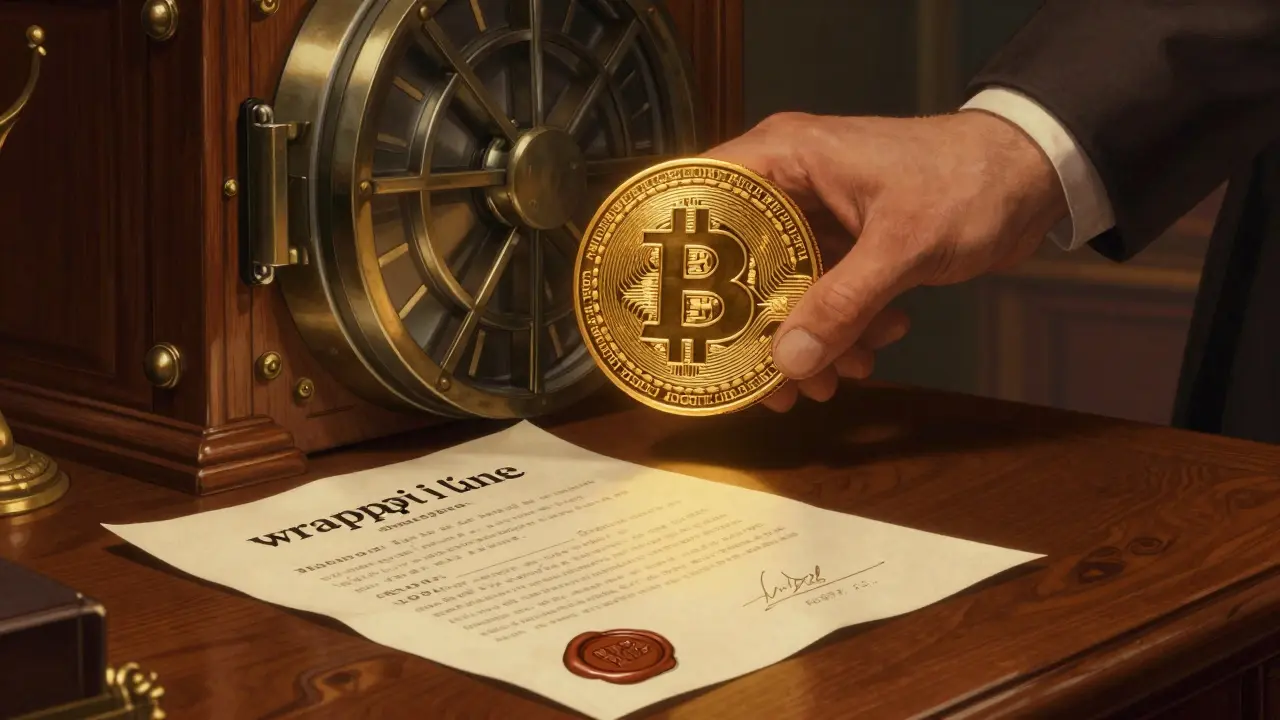
Imagine you have a gold bar locked in a vault. You can’t take it out to buy coffee, but you want to use its value for daily transactions. So, you get a receipt-a paper certificate-that proves you own that gold. You trade the paper instead of moving the heavy metal. That is the core logic behind wrapped tokens in blockchain.
In the crypto world, "wrapping" and "unwrapping" are not about physical packaging. They are cryptographic processes that allow one cryptocurrency to function on another blockchain. This mechanism solves one of the biggest problems in decentralized finance (DeFi): interoperability. Bitcoin cannot natively run smart contracts like Ethereum does. But by wrapping Bitcoin, we can use it within Ethereum’s ecosystem. Let’s break down how this works, why it matters, and where the risks lie.
What Is Wrapping in Blockchain?
Wrapping is the process of locking an original cryptocurrency asset in a smart contract and issuing a corresponding token on a different blockchain network.
Think of it as a digital exchange rate fixed at 1:1. When you wrap an asset, you aren’t creating new money; you are creating a representation of existing money. The most famous example is Wrapped Bitcoin (WBTC). If you hold 1 BTC, you can send it to a custodian service. They lock your BTC in a secure wallet and mint 1 WBTC on the Ethereum network for you. Now you have an ERC-20 token that behaves exactly like Bitcoin in value but functions like Ether in utility.
This process enables three critical jobs:
- Cross-Chain Liquidity: It allows assets from isolated blockchains to flow into larger ecosystems.
- Smart Contract Compatibility: It lets non-programmable coins participate in DeFi protocols like lending, borrowing, and yield farming.
- Price Stability Representation: It ensures the wrapped token tracks the price of the underlying asset perfectly, assuming no market manipulation or bridge failure.
The Mechanics of the Wrapping Process
The wrapping process relies on trustless or semi-trustless systems involving smart contracts and often third-party custodians. Here is the step-by-step workflow for a typical centralized wrapping model, which is still the industry standard for major assets like WBTC.
- Deposit: You send your native asset (e.g., Bitcoin) to a specific address controlled by a custodian or a multisig wallet.
- Locking: The custodian confirms the transaction on the source blockchain and locks the funds in a cold storage wallet. These funds are now illiquid; they cannot be moved without authorization.
- Minting: Upon confirmation, the smart contract on the target blockchain (e.g., Ethereum) mints an equivalent amount of wrapped tokens (e.g., WBTC) and sends them to your wallet address.
- Usage: You now hold the wrapped token. You can trade it, stake it, or use it as collateral in DeFi apps.
For decentralized alternatives, such as those using atomic swaps or hash-time-locked contracts (HTLCs), the process removes the central custodian. Instead, cryptography ensures that if one side doesn’t fulfill the swap, the funds are returned. However, these methods are less common for large-scale stablecoin-like wrappers due to complexity and liquidity fragmentation.
Understanding the Unwrapping Process
Unwrapping is the reverse procedure where a wrapped token is burned to release the original underlying asset back to the user.
You don’t just delete the wrapped token. Burning is crucial because it maintains the 1:1 peg. If people could unwrap without burning, there would be more wrapped tokens than actual underlying assets, causing hyperinflation of the wrapper and crashing its value.
Here is how unwrapping typically happens:
- Burning: You send your wrapped tokens (e.g., WBTC) to a burn address or call a burn function on the smart contract. These tokens are permanently removed from circulation.
- Verification: The system verifies that the tokens were indeed destroyed.
- Unlocking: The custodian or automated protocol unlocks the equivalent amount of the native asset (e.g., BTC) from the reserve wallet.
- Withdrawal: The native asset is sent to your specified wallet address on the original blockchain.
This cycle ensures that the total supply of wrapped tokens always equals the total amount of locked native assets. Transparency dashboards often show this ratio in real-time to build user confidence.

Why Do We Need Wrapped Tokens?
Blockchain networks are silos. Ethereum doesn’t talk directly to Solana. Bitcoin doesn’t talk to Polygon. Without wrapping, each chain is an island with its own limited liquidity. By wrapping assets, we create bridges between these islands.
Consider a scenario where you want to earn interest on your Bitcoin. Bitcoin’s native protocol offers no staking rewards. However, Ethereum has hundreds of lending protocols like Aave or Compound. By converting BTC to WBTC, you can deposit it into Aave and earn yield. This expands the utility of every single cryptocurrency exponentially.
Furthermore, wrapped tokens enable complex financial instruments. Synthetic assets, for instance, are often built on top of wrapped stablecoins. If you want exposure to Tesla stock prices on-chain, you might use a platform that locks wrapped USDC as collateral to issue a synthetic Tesla token. The entire DeFi economy relies heavily on this layer of abstraction.
Risks and Security Concerns
While wrapping sounds convenient, it introduces significant risks. The primary concern is counterparty risk. In centralized wrapping models, you are trusting a company (like BitGo for WBTC) to hold your actual Bitcoin securely. If their keys are stolen, hacked, or if they go bankrupt, your wrapped token becomes worthless paper.
Another major risk is smart contract vulnerabilities. The code that handles minting and burning must be flawless. Bugs in these contracts have led to millions of dollars in losses across various projects. For example, if a bug allows unlimited minting without deposits, attackers can drain the reserve.
Additionally, there is the risk of de-pegging. During times of extreme market volatility, the price of the wrapped token might temporarily diverge from the underlying asset due to liquidity issues or panic selling. While arbitrageurs usually fix this quickly, users holding during the crash can suffer losses.
| Feature | Centralized Custody (e.g., WBTC) | Decentralized Bridge (e.g., Atomic Swaps) |
|---|---|---|
| Trust Requirement | High (Trust the custodian) | Low (Trust the code/cryptography) |
| Liquidity | Very High | Fragmented/Lower |
| Security Risk | Hacking of custodian wallets | Smart contract bugs |
| Transparency | Audits required | Fully on-chain verifiable |
| Speed | Fast (minutes to hours) | Variable (depends on finality) |
Popular Examples of Wrapped Assets
Several wrapped tokens dominate the market today. Understanding these helps you navigate DeFi safely.
- Wrapped Bitcoin (WBTC): The largest wrapped asset. It brings Bitcoin liquidity to Ethereum. Backed by BitGo and a federation of merchants.
- Wrapped Ether (WETH): Native ETH is not an ERC-20 token. WETH wraps ETH into an ERC-20 format so it can interact seamlessly with DeFi protocols that expect standard tokens.
- Wrapped Staked Ether (wstETH): This is a "re-wrapped" token. Lido issues stETH when you stake ETH. wstETH represents stETH that has been deposited into certain protocols, accumulating yield over time.
- Polygon Bridged USD (MATIC-Peg): Used to move assets between Ethereum and Polygon chains efficiently.
The Future: Trustless Interoperability
The industry is moving away from centralized custodians. New technologies like LayerZero, Wormhole, and IBC (Inter-Blockchain Communication) aim to make wrapping trustless. These protocols use cryptographic proofs rather than human operators to verify that assets are locked on one chain before releasing them on another.
As blockchain technology matures, the distinction between "native" and "wrapped" may blur. Universal account abstractions and cross-chain messaging standards could allow assets to move freely without needing intermediate wrapped representations. Until then, wrapping remains the lifeblood of cross-chain finance.
Best Practices for Users
If you plan to use wrapped tokens, follow these guidelines to protect your capital:
- Verify the Peg: Always check the current price of the wrapped token against the underlying asset on a reliable charting tool.
- Research the Custodian: For centralized wrappers, look up the auditor reports and the reputation of the entity holding the keys.
- Use Reputable Bridges: Stick to well-established protocols with high total value locked (TVL) and active community monitoring.
- Monitor Smart Contracts: Check if the contract has been audited by firms like CertiK or OpenZeppelin.
- Diversify Exposure: Don’t keep all your assets in one wrapped form. Keep some in native assets to mitigate systemic bridge risks.
Wrapping and unwrapping are essential tools for modern crypto users. They unlock liquidity and functionality, but they require vigilance. Understand the mechanics, respect the risks, and you can leverage these processes to maximize your portfolio’s potential.
Is wrapped Bitcoin (WBTC) the same as Bitcoin?
No, WBTC is an ERC-20 token on the Ethereum blockchain that represents Bitcoin. It tracks the price of Bitcoin 1:1, but it exists on a different network. You can only redeem it for actual Bitcoin through the unwrapping process.
What happens if a wrapped token loses its peg?
If a wrapped token trades below the value of the underlying asset, arbitrageurs will buy the cheap wrapped token, unwrap it for the full value of the native asset, and sell the native asset. This profit-seeking behavior usually restores the peg quickly, unless there is a fundamental failure in the custody or smart contract.
Are wrapped tokens safe?
They carry additional risks compared to holding native assets. The main risks are smart contract bugs and custodial failure. While many wrappers are highly secure and audited, no system is 100% immune to hacks. Always assess the security model of the specific wrapper you are using.
Why do I need Wrapped Ether (WETH)?
Native ETH is not compliant with the ERC-20 token standard. Many DeFi protocols are built to accept only ERC-20 tokens. WETH wraps native ETH into an ERC-20 format, allowing it to be used interchangeably with other tokens in trading pairs and lending pools.
Can I unwrap my tokens anytime?
Generally, yes. Most reputable wrapped token services allow instant or near-instant unwrapping. However, during periods of extreme network congestion or technical issues, delays may occur. Always check the specific terms of the wrapping service.